How No Cap Space Built a Women's Basketball Media Company on beehiiv
How a premium podcast feed, templates that give back 30 minutes a day, and a no-code website let five busy people publish every single day.
Table of contents
At a Glance
Who: No Cap Space (NCS), an independent women's basketball media company
The founders: Chaunte’l Powell, Greer Engonga, Tyler DeLuca, Andrew Haubner, and Rashard Hall — met during the 2021 NCAA Women’s Tournament through Clubhouse and WNBA Twitter.
The team today: One full-time employee, Tyler DeLuca; the other four still work second jobs
On beehiiv since: November 2025, after starting on Substack
The hub: A daily 3 p.m. newsletter that pulls every channel into one inbox
The engine: Two podcasts a week, plus a premium paid feed of every video as audio
The reach: Nearly 4.5M YouTube impressions and a growing paid base
The voice: The old blogosphere energy of SB Nation and Grantland, not clickbait
By the Numbers
- 30 minutes saved every day with newsletter templates
- About 10% of paid subscribers use the premium podcast feed
- 2 to 3 podcast distribution steps removed
- Nearly 10,000 YouTube subscribers
Since the move to beehiiv, NCS reports downloads, plays, and reviews all trending up.
They Stopped Complaining and Built Their Own Table
No Cap Space did not start as a business plan. It started as a group of journalists who were tired of watching a sport they loved get covered like a footnote.
During the 2021 NCAA Women's Tournament, five of them found each other in Clubhouse audio rooms and on WNBA Twitter, watching games together and saying the same thing into the void: the sport was bigger than its coverage. ESPN sits in Bristol, Connecticut, and proximity shapes attention, so the West Coast and the South kept drawing the short straw. Andrew Haubner felt it covering Oregon and Oregon State, two programs forty-five miles apart that packed arenas while the national conversation looked the other way. Chaunte'l Powell, writing from Columbia, South Carolina, watched the rest of the country show up late to Dawn Staley.
They could have kept venting in Twitter Spaces. They chose the harder option.
“We can keep complaining about this on Twitter Spaces, or we can actually do the work and make our own table.”
Andrew Haubner, No Cap Space
What began as a once-a-month hang on YouTube became a daily media operation with a newsletter, two podcasts a week, video, a website, and a plan to lift other creators along the way. The throughline is what Haubner calls the missing middle. The WNBA is the front door, the thing that pulls a casual fan in. Once they are inside, No Cap Space points them toward the stories almost nobody else tells: smaller conferences, the Euroleague and FIBA, and the historical pieces that give the sport its memory. The tone is borrowed from a better era of sports writing, the SB Nation and Grantland blogosphere, human and fun rather than engineered for clicks.
Each founder brought a door to walk through. Haubner came from local TV, including CBS Sacramento and CBS Denver. Powell, the main columnist, came up through newspapers. Tyler DeLuca, the director of video content and the team's first full-time hire, brought a University of Oklahoma connection. Rashard Hall is a former Syracuse manager with real player relationships, and Greer Engonga, their fifth co-founder rounded out the group with an agency and sports-tech background. Together they had a built-in line to players and coaches from day one.
One Email at 3 P.M. That Holds the Whole Operation
If the podcast is the engine, the newsletter is the front page. Every day at 3 p.m., one email lands that pulls the entire operation into a single place: a recap of the day or night of games, every YouTube video from the last twenty-four hours, every podcast episode, the social posts, and a “good read” section that sends readers out to other writers, from ESPN columnists down to a newsletter with five hundred subscribers that deserves a wider audience.
Haubner learned the shape of this in local TV. At CBS, the station, the streaming channel, the evening news, and the sports network were not rivals fighting over the same viewers. They fed each other.
“Instead of newsletter being one boat and podcast being a separate boat, they are all different paddles on the same boat.”
Andrew Haubner
Most creators do the opposite by accident. They scatter themselves across a website, YouTube, Apple Podcasts, TikTok, and Instagram, then ask the audience to keep up with all five. No Cap Space treats that fragmentation as the enemy. The newsletter is the cure, the modern version of a Sunday edition: one reliable place, at the same time every day, where a reader can find everything without chasing it across five apps.
How a Twice-Weekly Podcast Pays for Itself
NCS had a podcast before beehiiv, but the premium feed never advanced things the way the team wanted. On beehiiv, the podcast became a real subscription perk. Every YouTube video the team posts is converted to an MP3 and dropped automatically into a premium feed for paid subscribers, the audio-first crowd who want something to play at the gym, on a walk, or in the car. About one in ten paid subscribers pulls those episodes, and the cost of serving them is close to zero. And because beehiiv takes no revenue share on premium subscriptions, every dollar from that feed stays with the team.
“It takes absolutely nothing on our end. That is the thing that makes the value prop of the subscription significantly higher to some people.”
Andrew Haubner
A few simple pieces keep the whole thing turning, and most of them run themselves:
- Premium podcast feed: a paid-subscriber-only feed of every episode, the carrot that raises the value of a subscription.
- Automatic audio: every video becomes an episode without anyone touching it, so the work is to download the MP3, reuse the title and bio, and publish.
- Native embeds: the podcast plays on the site and in the newsletter, which replaced an old Spotify-plus-third-party workaround that added two to three steps every time.
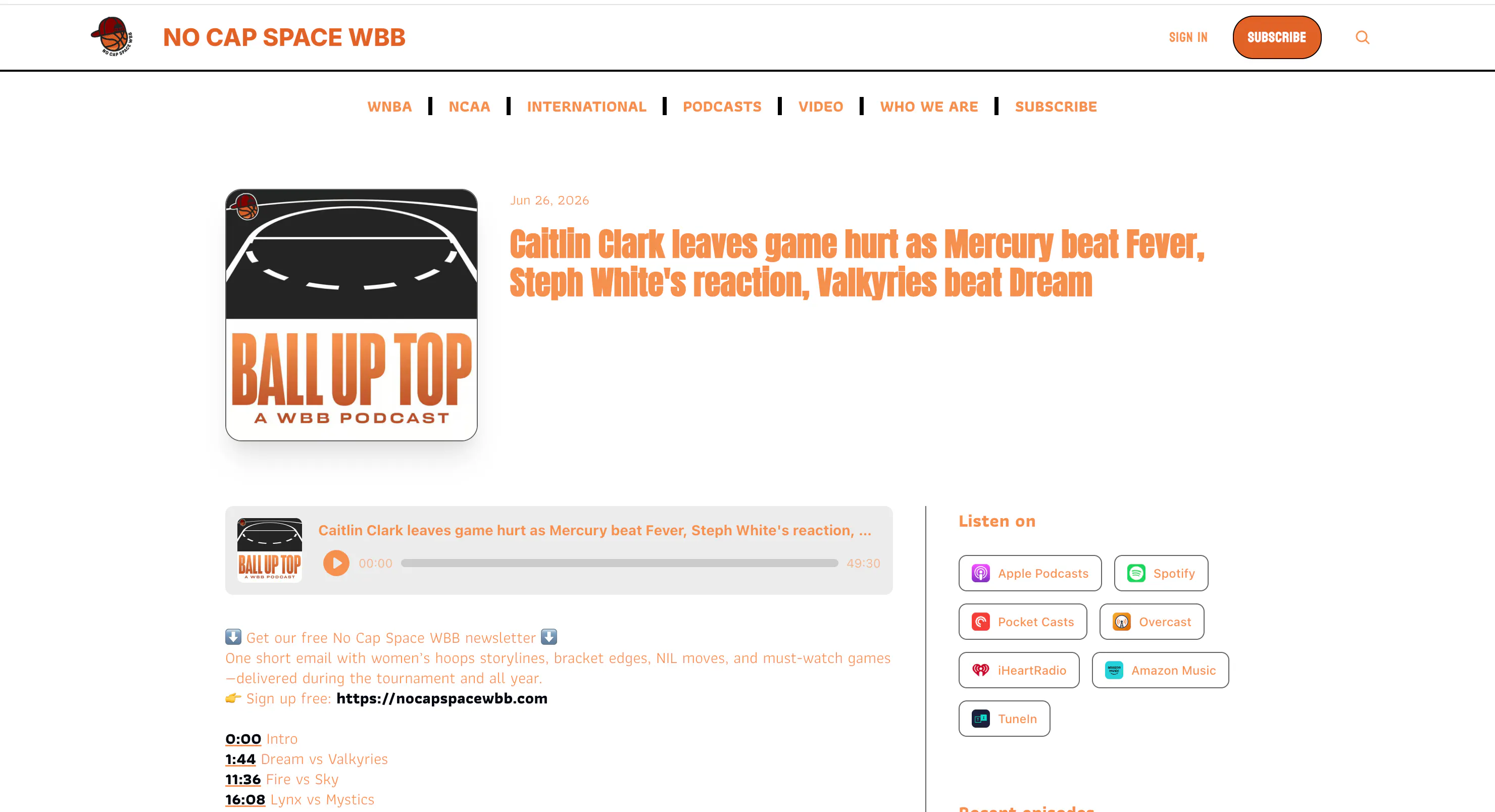
- A subscription widget: parked at the bottom of the landing page as a twice-weekly reminder that the show exists.
- A fan hotline: a Gmail voicemail inbox feeds Tyler's Friday segment and gives listeners a reason to leave reviews, which feed the algorithm in turn.
Before and After beehiiv
Paid podcast feed
- Before (Substack & Spotify): Available, but the platform took a revenue share.
- After (beehiiv): Became a core paid perk with no revenue share.
Podcast distribution
- Before: Publish on Spotify, then move everything to a third-party site, requiring two to three extra steps.
- After: Upload the MP3, reuse the title and description, and publish.
Daily formatting
- Before: Built each newsletter from scratch, taking roughly 30 minutes per day.
- After: Used templates, reducing formatting time to almost zero.
Newsletter analytics
- Before: Analytics were difficult to trust.
- After: Gained access to cohort analysis and clearer open and click data.
Podcast analytics
- Before: Data was split between Spotify and a third-party hosting platform.
- After: Downloads, plays, and reviews were tracked in one place, with metrics trending upward.
Different Doors, One Community
The channels are not just copies of each other. Sources have cold-emailed Haubner off a YouTube video and off the newsletter, proof that each surface reaches someone the others miss. The most devoted fans take all of it: they subscribe to the newsletter, pay for YouTube memberships, and hang out in the Discord. So the strategy is not to keep audiences in their lanes. It is to build highways between every medium, linking the YouTube show inside the newsletter and plugging the newsletter on the YouTube channel, so a reader can move from one to the next without friction.
The longer goal is to take the community offline. In five to ten years, Haubner wants subscribers meeting up for watch parties in their own cities, the way The Sports Bra has turned a single women's sports bar in Portland into a movement.
“You like women's basketball, I like women's basketball. You live in Seattle, I live in Seattle. Let's meet up and watch a game. That's what we want to create.”
Andrew Haubner
What Lets Five Busy People Publish Every Day
A daily operation run mostly by people with other jobs only works if the tools carry the weight. Three features changed the day to day.
Templates that give back half an hour.
Rebuilding the newsletter layout from scratch every afternoon used to eat a solid thirty minutes before Haubner could even start writing. Templates erased that. Now every section has a home, the formatting is done, and the time goes to the words instead of the wiring.
Newsletter analytics he can trust.
Cohort analysis and clearer reporting on click and open rates gave the team confidence that their growth is real engagement, not an algorithm inflating a number.
“I can frankly trust the numbers. The people coming to us are actually engaged, not just getting something spit out at them.”
Andrew Haubner
A website that looks like a network.
None of the founders is a web developer, yet the site they shipped reads, in Haubner's estimation, in the same league as ESPN, The Ringer, or CNN. Templates gave him a professional starting point, and the freedom to customize meant he was never boxed in by one. beehiiv's AI tools, including a Claude integration, stay optional, which matters to journalists who do not want a platform deciding for them.
“If I don't want to use it, I don't have to. But if I want to make my life easier, I can ease myself into it. It's a choice.”
Andrew Haubner
An SB Nation for Women's Basketball, on Fairer Terms
The boldest ambition is structural. Haubner wants to rebuild something like the old SB Nation network, where a central hub lifted dozens of team-specific sites, but on terms that actually favor the creators. Picture No Cap Space as the front door that features an independent newsletter such as Valkyries Beat covering Golden State, sends readers to it, and helps it get found through Google, DuckDuckGo, and Bing, while that creator keeps every dollar of their own subscription revenue and stays fully independent.
It is a bet on collaboration over competition, which Haubner frames as both a business model and a worldview.
“Strength of many beats strength of one. The way out of this is figuring out how we stop competing with each other and uplift each other on equitable terms.”
Andrew Haubner
Chasing the White Whale: Monetization
The next mountain is podcast and video money. With nearly 10,000 YouTube subscribers and strong watch hours, NCS still hits the same wall with agencies that want to see 20,000 views before they will talk, even when the engagement underneath is there. That is exactly the gap beehiiv's roadmap is built to close, with premium podcast subscriptions and analytics, dynamic ad insertion for podcasts, and tighter video and YouTube sync so creators stop logging in everywhere. When Haubner heard dynamic ad insertion and a podcast ad network were coming, his response was simple.
“That is literally our white whale right now. So that is just music to my ears.”
Andrew Haubner
Start Using beehiiv
No Cap Space is proof that a small team can run a real media company, the newsletter, the podcast, the video, the website, and the network ambition, from one platform. The podcast is the engine and the newsletter is the front page, and beehiiv is the floor under both: a premium audio feed that runs itself, templates that give you your afternoon back, analytics you trust, and a site that looks like a network. If you are building something bigger than a newsletter, start using beehiiv.
Related Case Studies

How AI Central Built a 300,000-Reader Media Brand on beehiiv
Alex Fiore treats his newsletter like an investment portfolio, and beehiiv's data, API, and monetization tools are how he manages it.

How Brex Turns Newsletter Subscribers Into Event Attendees
The Channel Behind Brex's Event Growth: A Newsletter That Does the Work
How The Small Bow Left Substack for beehiiv and Grew Open Rates by 35%
A recovery newsletter breaks free from Substack, builds its own branded platform on beehiiv, and immediately sees a 35% jump in open rates
